Kano Osanobu “Portrait of Monk Kenko(copying the work of Tan’yu)”
- Home
- Our collection
- hanging scroll
- Japanese Painting
- Kano school
- Kano Osanobu “Portrait of Monk Kenko(copying the work of Tan’yu)”
Kano Osanobu “Portrait of Monk Kenko(copying the work of Tan’yu)”
| IItem No. | |
|---|---|
| Title | “Portrait of Monk Kenko(copying the work of Tan’yu)” |
| Overall size | |
| Artwork size | |
| Artist | By Kano Osanobu (1796-1846) |
| Date Created | Early 19th century |
| Price | ¥500,000(excluding tax) |
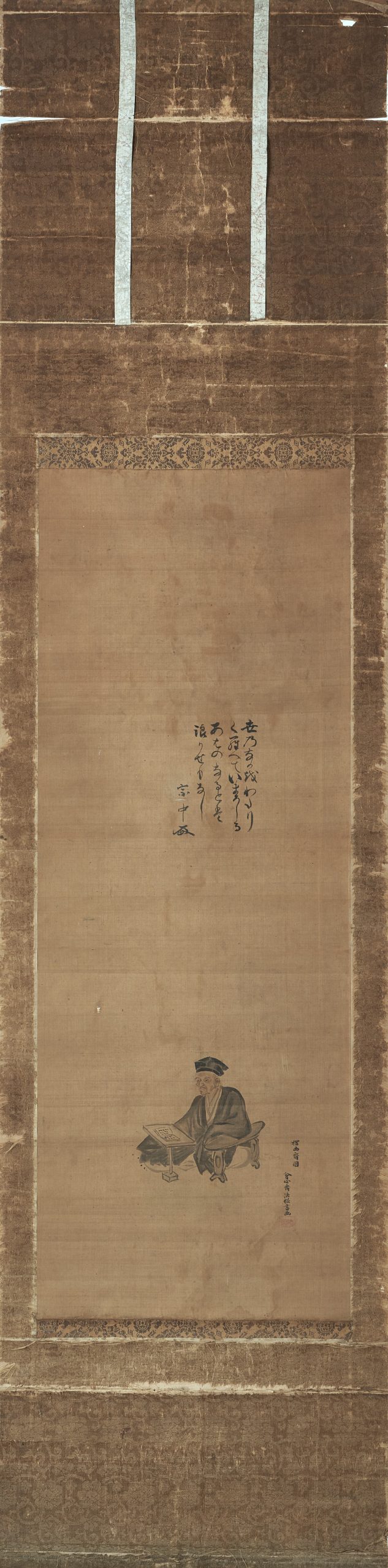
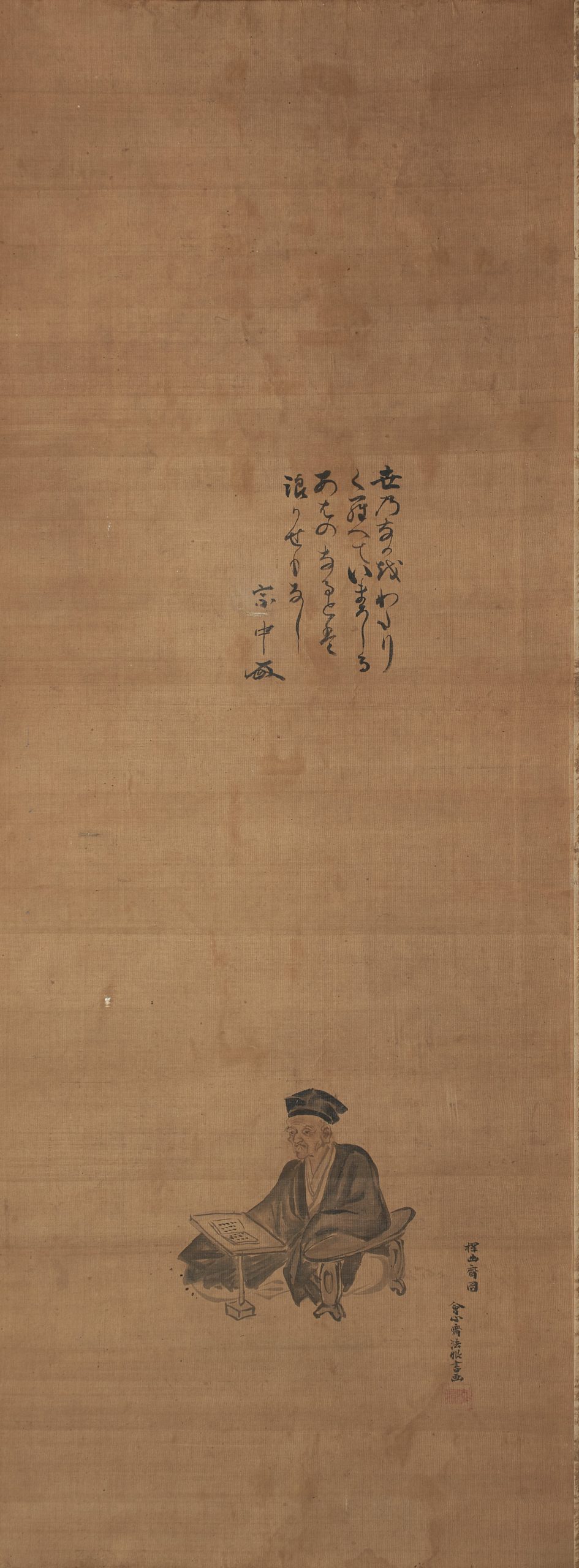
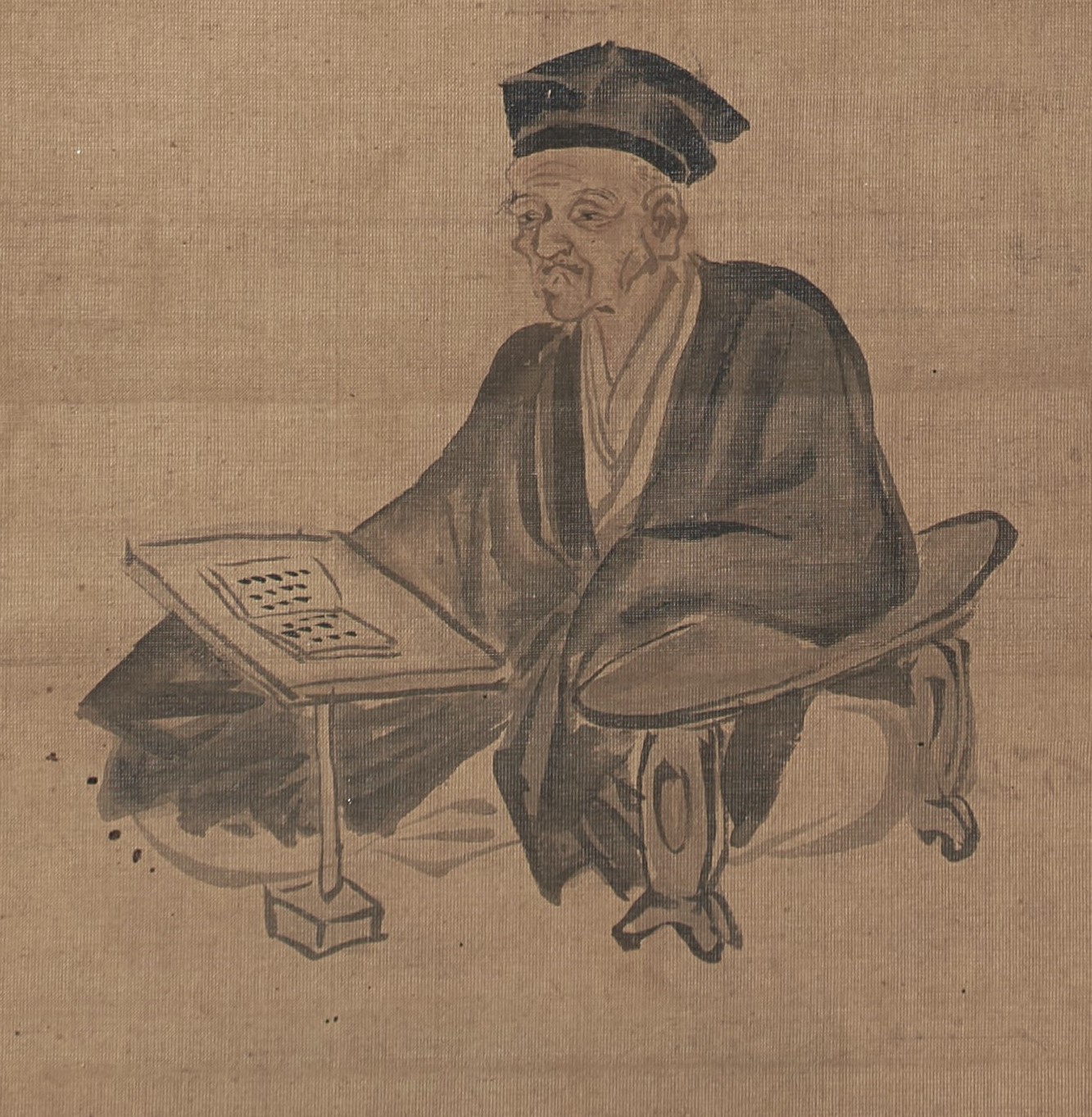
Portrait of an old man leaning on his elbow. From the inscription, we know that this work is a reproduction of a portrait of Monk Kenko by Kano Tanyu, a leading painter of the Edo Kano school. The artist is Kano Osanobu, who was also active in Edo. The original work copied is probably “Portrait of Monk Kenko” in the collection of Kanazawa Bunko.
Let us compare the two works in terms of facial expression. They are very similar in the shape of the hood, the three lines drawn on the forehead, the eyebrows that become hairier toward the end of the eyebrows, and the mouth that is curved into a hiragana “へ” character.However, there is also a difference in the nose of Monk Kenko painted by Tan’yu: the nose is drawn with gentle lines, whereas in this work, it is drawn with a slightly eagle nose. However, there is also a difference: Kanayoshi Houshi, painted by Tan’yu, has a nose with gentle lines, whereas in this work, the nose is painted with a slightly eagle nose. This shows the uniqueness of Osanobu.
Then, let us compare the clothing. In Tanyu’s work, shading is applied along the wrinkles of the clothes to express a three-dimensional effect. Following this, Osanobu also expresses wrinkles with dark ink. The positions of the wrinkles in the kimono in both works are in perfect alignment.
The composition is also the same, with the left elbow resting on the side of his arm, sitting cross-legged, and reading intently from some kind of calligraphy on a writing desk. It is clear that Osanobu carefully observed the original painting and tried to reproduce it.
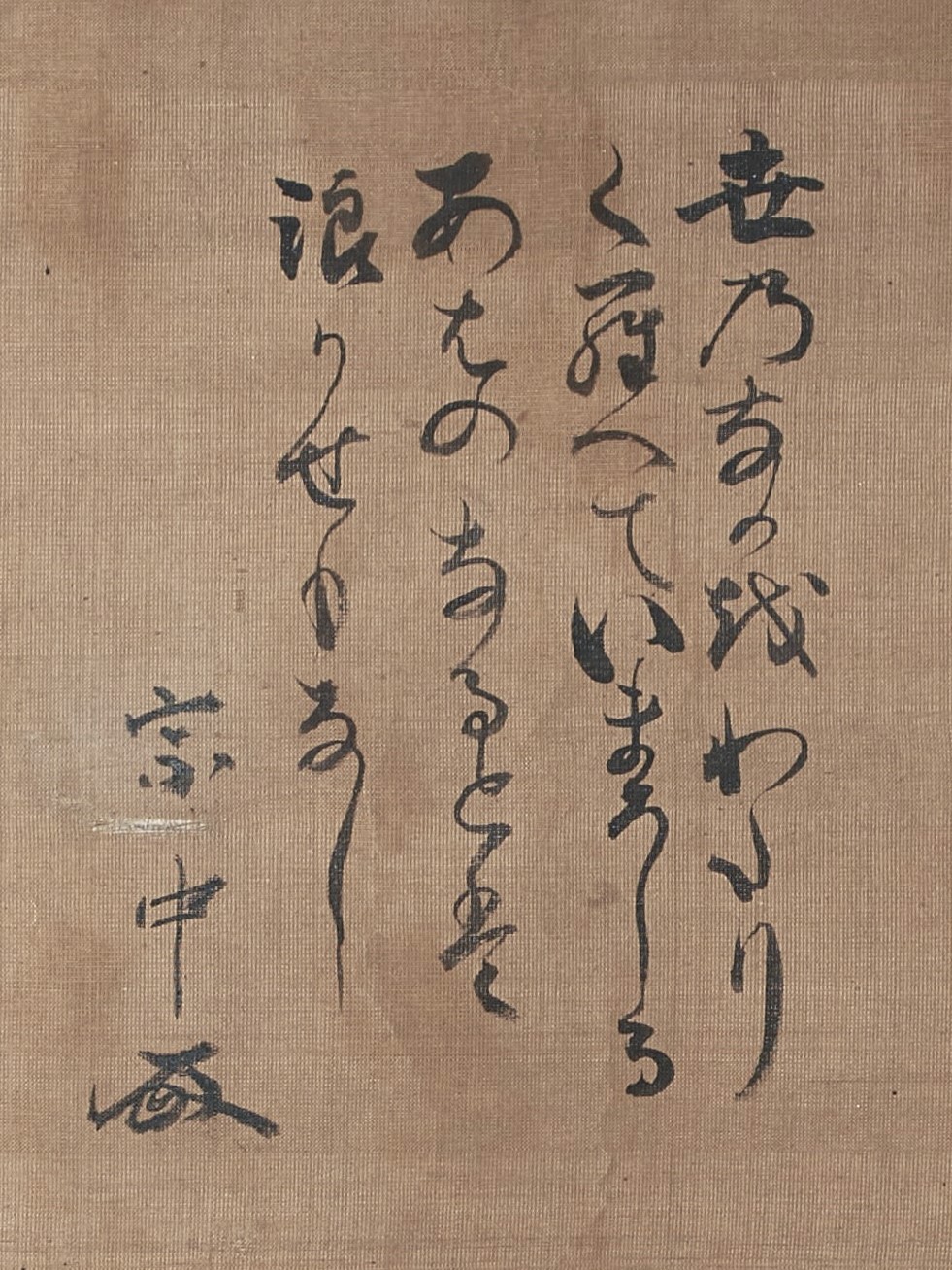
A waka poem is inscribed at the top of the screen.
“世の中を渡り比べて今ぞしる 阿波の鳴門の波風もなしを”
(Yononaka wo watari kurabete imazo shiru awa no naruto no namikaze mo nashi wo)
This is a well-known waka poem. It means, “Compared to the difficulty of crossing the world, I now know that the sea of Naruto in Awa is calm and windless”.
This waka is very famous and is quoted by Monk Kenko in his private collection of poems. In addition, in the opening section of “Tsurezuregusa Esho,” there is a picture of Monk Kenko with his legs collapsed and his book spread out as in this work, and this poem is written on the page.
The combination of Monk Kenko in a relaxed posture and this waka poem seems to have been passed down through the generations until Osanobu’s time. This may have been the inspiration for the creation of this work.
Kano Osanobu (1796-1846) was the ninth generation of the Kano family of Kobikicho and went by the name of 會心斎(Kaishinsai).
He received the title of Hogen in 1819, and was subsequently appointed Hoin in 1834 (Tempo 5), which indicates that this work was created between 1819 and 1834.
He is known for his work on the barriers of the Nishinomaru and Honmaru of Edo Castle, as well as for his many reproductions of old paintings. This work is considered to be one of his most enthusiastic reproductions.
As an antique, it may have some scratches or blemishes. We recommend that you visit our store to check the condition.
If you wish, we will send you detailed photos of the item, so please feel free to contact us.